

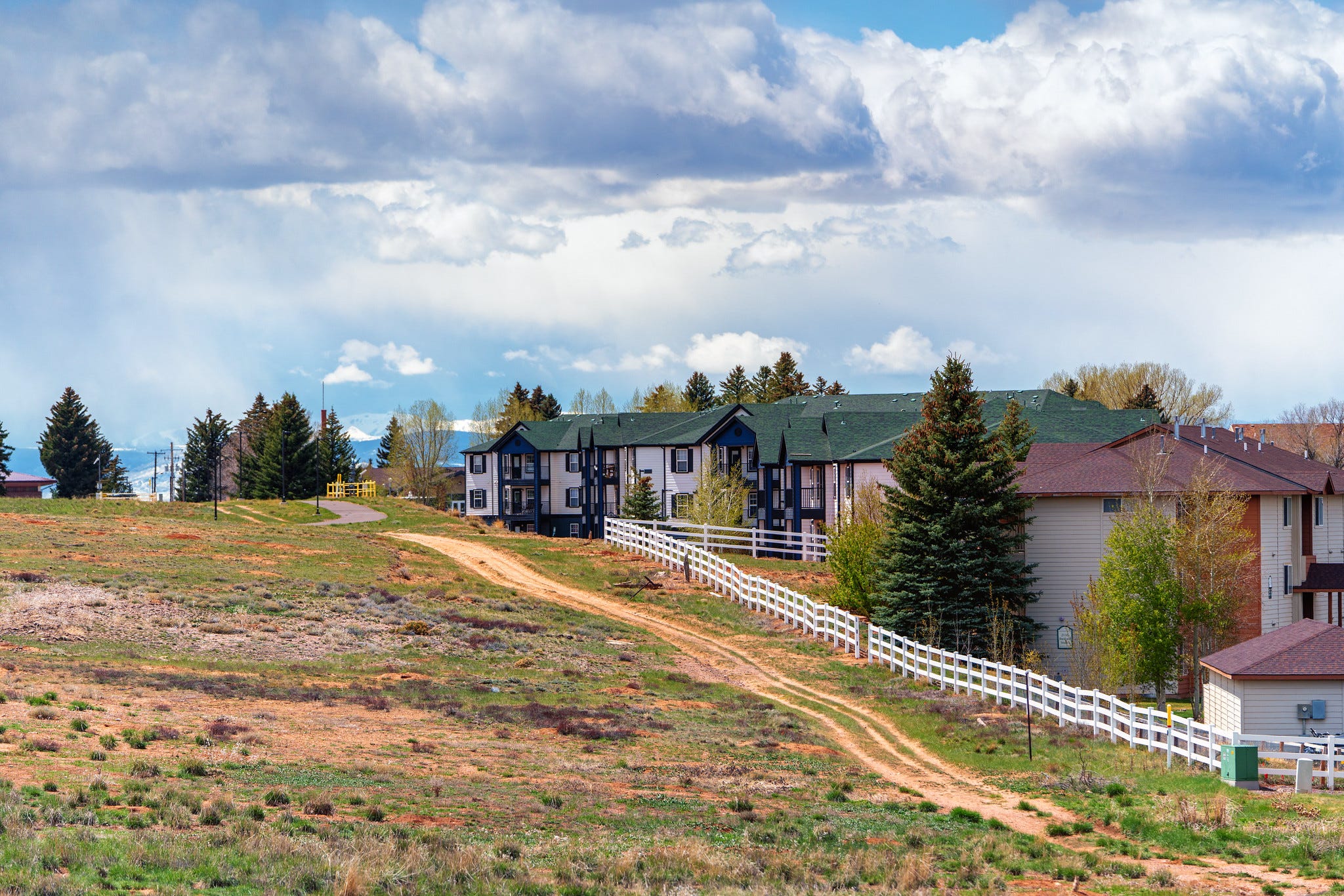
In the latest step of an ongoing push for more housing, Laramie City Councilors approved two actions Tuesday meant to spur development.
Various local studies and statewide reports show Albany County is short several thousand homes, and it will have to massively ramp up construction to meet future demand.
The council’s actions this week are meant to grease the wheels.
During the consent agenda vote, the council agreed to defer city fees for a planned apartment complex, reducing the upfront costs to its developer in a ploy to streamline construction.
Later in the same meeting, the councilors officially committed a $5 million fund for affordable housing projects they had set aside in last year’s budget. The plan, according to City Manager Todd Feezer, is to “recapture” that $5 million as it’s deployed to “make that money work more than one time for us.” The resolution passed with a unanimous 8-0 vote.
Councilor Will Bowling said the actions show the city is committed to addressing “the single most important crisis that faces us.”
“I do think that housing-ready infrastructure is one of the largest single barriers to making sure that affordable housing happens in communities like ours,” Bowling said before the vote on the affordable housing fund. “What this shows is a real commitment to working on that issue from our city leaders [and] from our city staff.”
In the last half-decade, city leadership has peeled back restrictive zoning regulations, reduced parking requirements, legalized accessory dwelling units in single-family neighborhoods and streamlined other regulations, all in an effort to foster more private housing development.

In the past two years, the city has shifted its focus toward backing community efforts like the Albany County Housing Coalition and throwing its weight behind specific housing proposals like those for the Old Slade footprint and for a patch of undeveloped land on the West Side.
The actions approved Tuesday build on those efforts and likely presage later council actions in the future.
Laramie Lofts fee deferral
A company named 3rd Street Operations plans to build a set of three 42-unit apartment buildings at 214 South Adams Street, to be dubbed “Laramie Lofts.” The property is in West Laramie, near Big D and Maria’s Mexican Grill and Cantina.
3rd Street Operations is registered in Sheridan, according to Wyoming Secretary of State records, and is doing business locally as “Laramie Lofts,” according to city documents.
Clocking in at 126 planned housing units, this one development could add double the number of housing units Laramie builds in a typical year, which is around 60.
The agreement councilors inked Tuesday will defer all fees “imposed by the City related to the development and construction” of those 126 units. Importantly, the agreement does not eliminate those fees. Rather it defers the developer’s payment.
The city will still be paid, but deferral to a later date allows the developer to “manage their financial arrangements and keep the project moving while securing the City’s position related to the construction of the units,” according to a city staff summary.
“The agreement allows the Developer to construct the three buildings and improvements, receive all required permits, inspections, and installations provided by the City for each building through the completion of their construction,” the summary states. “The developer agrees that the units will be constructed in accordance with all applicable City codes or ordinances, the units will not be sold, and that the Certificate of Occupancy will be held by the City until all fees that would have been imposed by the City are satisfied.”
The deferral agreement had unanimous support among the council and from a majority of the residents who spoke on the item. But it did have one detractor, local landlord Brett Glass, who said he was suspicious.
“There’s a lot of questions about what is this about, who’s financing it, what corporation’s behind it … Are they trustworthy? Are they going to be a good landlord?” he said during public comment. “This is very mysterious, and it seems as if a lot of this is done to obfuscate what’s really going on. I hope that’s not the case, but it sure seems that way.”
The development has been in the works for some time. City Manager Feezer gave it a shoutout during a December council meeting, speaking to the long journey the project had taken thus far.

Originally planned as “micro-apartments” for an area south of the city center, the project was delayed by a death on the development team. The project reemerged as the West Laramie proposal it is today.
At that December meeting, Feezer also touted the project’s potential to boost business in West Laramie. A larger, denser population, he said, means more customers for nearby businesses.
“The more people we get, the more commercial that turns on,” Feezer said. “Businesses are interested in people that go by their front door, and any growth could lend itself to that future grocery store or something else that continues to create vibrancy and brings commercialism.”
Supportive public comments this week focused on the direct impact the project could make on the city’s housing stock.
“I actually believe this should be the norm and not the exception,” said Tom Mattimore, who helms the city’s planning commission. “We need to be flexible if we’re going to build anything in this town, and I think if we can do that, we can be flexible and we can get some stuff built.”

Fee deferrals could one day become the norm in Laramie, according to the city’s agreement summary, which states:
If this process proves successful and continues to be supported by the Laramie City Council across multiple projects a future Code revision may be brought forward by staff eliminating the need for council approval with this process.
Councilors approved the fee deferral during their consent vote — a vote they take at the outset of meetings to approve a batch of largely uncontroversial or otherwise unremarkable business items.
A $5 million fund to enable housing development
Nearing the conclusion of Tuesday’s short council meeting, city leaders also approved the movement of $5 million into a fund that will support affordable housing development.
Specifically, the $5 million would support the buildout of infrastructure — pipes, roads and other city hardware — where developers are looking to construct homes.
Those upfront infrastructure costs are a lot larger than they used to be and they can drive up the price of the homes being built, explained Fred Schmechel, who serves as executive director of the Albany County Housing & Land Trust and chair of the Urban Renewal Agency.
“It used to be that the legislature would fund our municipalities to the point that they could build out a lot of this infrastructure themselves [and] that was empowered by the fact that this infrastructure didn’t cost nearly as much as it does today,” he said during public comment. “When we have shifted that business model over the past 20 or so years into being put on the developer, we’re passing those developer costs on to the people who are buying the houses.”
The $5 million is not new money.
When city councilors approved last year’s budget, they set aside $5 million to support affordable housing development. That included:
$2 million from general fund reserves (generated by the sales and use taxes collected during wind development in Albany County);
$2 million from water fund reserves; and
$1 million from wastewater fund reserves.
The money was earmarked, but not spent, in fiscal year 2026, so the $5 million was carried over from the FY26 budget to the FY27 budget approved last month.
“We decided to save the funds and commit those because we could see what it would do,” Mayor Sharon Cumbie said. “Here we are, beginning that process.”

The resolution Tuesday officially establishes a “housing enabling infrastructure program” under the city’s economic development fund.
“We’re putting some wheels on the bus tonight,” City Administrative Services Director Jenn Wade said. “Giving it that vision, and then also making that formal appropriation of financial resources that’s necessary to stand up the program.”
In practice, this money will be spent as the city signs agreements with developers — agreements that stipulate how the city will eventually “recapture” some or all of the aid that it offers. A staff summary notes:
The City Manager recommends using this program to incentivize housing construction for shovel-ready projects by creating agreements with developers that recapture all or a portion of program funds back to the City, while ensuring that public funds are used for public infrastructure. Agreements would begin to be drafted after the program is established.
City councilors asked for specifics about those agreements, but staff, including City Manager Feezer, said each will be unique.
“Each agreement will have its own benefit, depending on what the support mechanism is for these developments,” he said. “Are they low-income housing? Are they efficiency units? Are they single-family residential within a certain price range? [Those] will all be what staff evaluates when we’re calculating and negotiating some sort of recapture, so they will all be individually negotiated.”
Vice-Mayor Micah Richardson said both council actions — the fee deferral and the housing support fund — could “make a big impact on housing.” Councilor Matt Lockhart said the council’s votes should dispel any “us against them” narrative about developers and city council.
“Because you hear that all the time: ‘Well, the city won’t let me do this,’ and ‘They want me to do this,’” Lockhart said. “Well, this shows that we’re committed to helping grow Laramie and team up with the developers to help grow the community.”
That is all well and good. However, there is no mention of water supply or usage. I went back and read your 2022 post on securing more water rights from the Laramie River. I have also read about the 1930's and 1940's Wyoming droughts on Laramie's water supply. If we have more periods like the poor snow pack and little rain and an increasing population, at some point the supply and population will come into conflict.
Excellent coverage of these potential housing solutions. The whole region could learn from this.