
Laramie rails against proposed statewide book ban
The ban targets school and public libraries, prohibiting what it defines as “sexually explicit” work. Laramie residents describe it as an assault on free speech, public education, and LGBTQ+ identity.

A draft bill before Wyoming’s Joint Judiciary Committee would ban broadly defined “sexually explicit” books in school and public libraries. It would also empower activists, even those from outside the state, to sue local districts for non-compliance.
Laramie residents vociferously opposed the bill, and asked their lawmakers to do the same, during a special meeting of the Albany County School Board on Wednesday. The meeting was attended by Rep. Ken Chestek (HD-13) and Sen. Gary Crum (SD-10).
Laramie High School librarian Stefanie Hunt was one of several local stakeholders invited to comment on the proposed legislation.
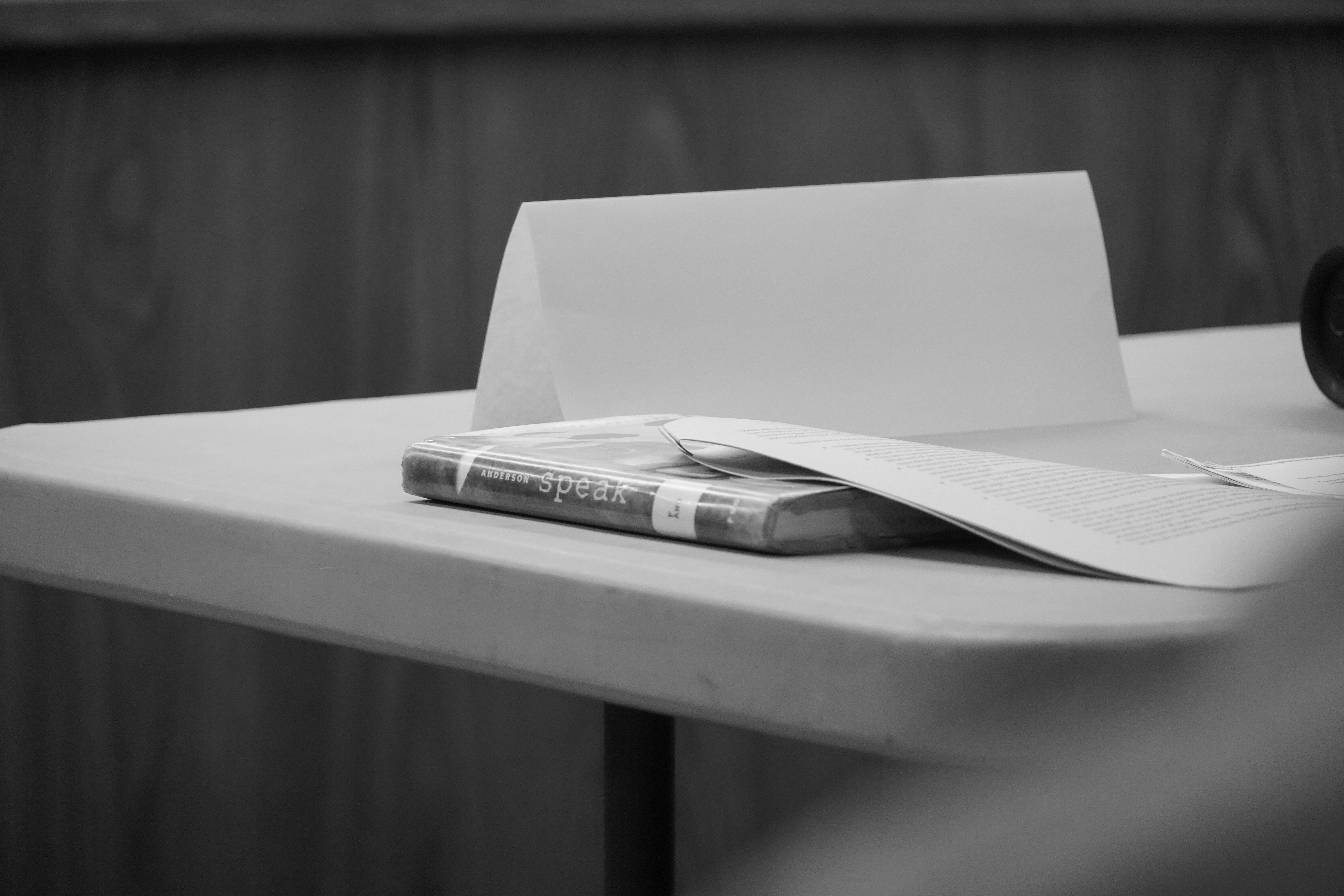
Facing the school board and lawmakers, with a packed room behind her, Hunt held up Laurie Halse Anderson’s young adult novel Speak, which she said “is a book about a girl who is finding her voice after sexual assault.”
“It has helped countless teens find their own voice, and above all, this story has actually opened conversations about consent and recovery,” Hunt said. “The broad definition of ‘sexually explicit’ could wrongfully remove stories like this from our library — which actually removes safe, constructive conversations about sensitive issues.”
Hunt demonstrated the book’s power by reading anonymous sticky notes she had found in the high school’s copy. Those notes, presumably written by student readers, engage with the text of the work, with one making reference to “our assaulters” and another musing about “growing into a woman without knowing what a woman is.”
The notion that books empower and protect students is not a new one. It’s an argument supported by the likes of Scientific American and the American Psychological Association. It was also born out in the public comments that concluded Wednesday’s meeting.
Resident Peggy McCrackin said she had raised her kids to love libraries and now takes her grandkids to the public library “every week.”
While the bill’s supporters have touted it as a way to shield kids from inappropriate material, McCrackin said books, not book bans, are what protect children.
“We didn’t have access to sex education [when I was] a kid, and that led many of us to be exceedingly vulnerable as a child and expose us to sexual assault and exploitation,” McCrackin said. “I was a victim of that as a child. We need to make sure that we do things to keep that from happening to our children.”
The draft bill bans all “sexually explicit” material — making no allowance for works about recovery, works that come highly recommended by library or literary organizations, or works which hold any other recognizable value.
The ban is not limited to school libraries, but also applies to the children’s sections of public libraries.
The draft bill imposes a steep fine for violations. As written, it establishes a $50,000 payout for those who successfully bring a claim against a school or county library. Opponents warn this provision will incentivize attacks on public education and local libraries from people with no connections to the schools and communities they’ll target.
The current draft includes a broad definition of “sexually explicit” — outlining specific sex acts in such detail that elected officials have been shy to read it in public. It bans all content meeting that definition, which could include even sex ed and STD prevention material, as well as classic literature and religious texts.
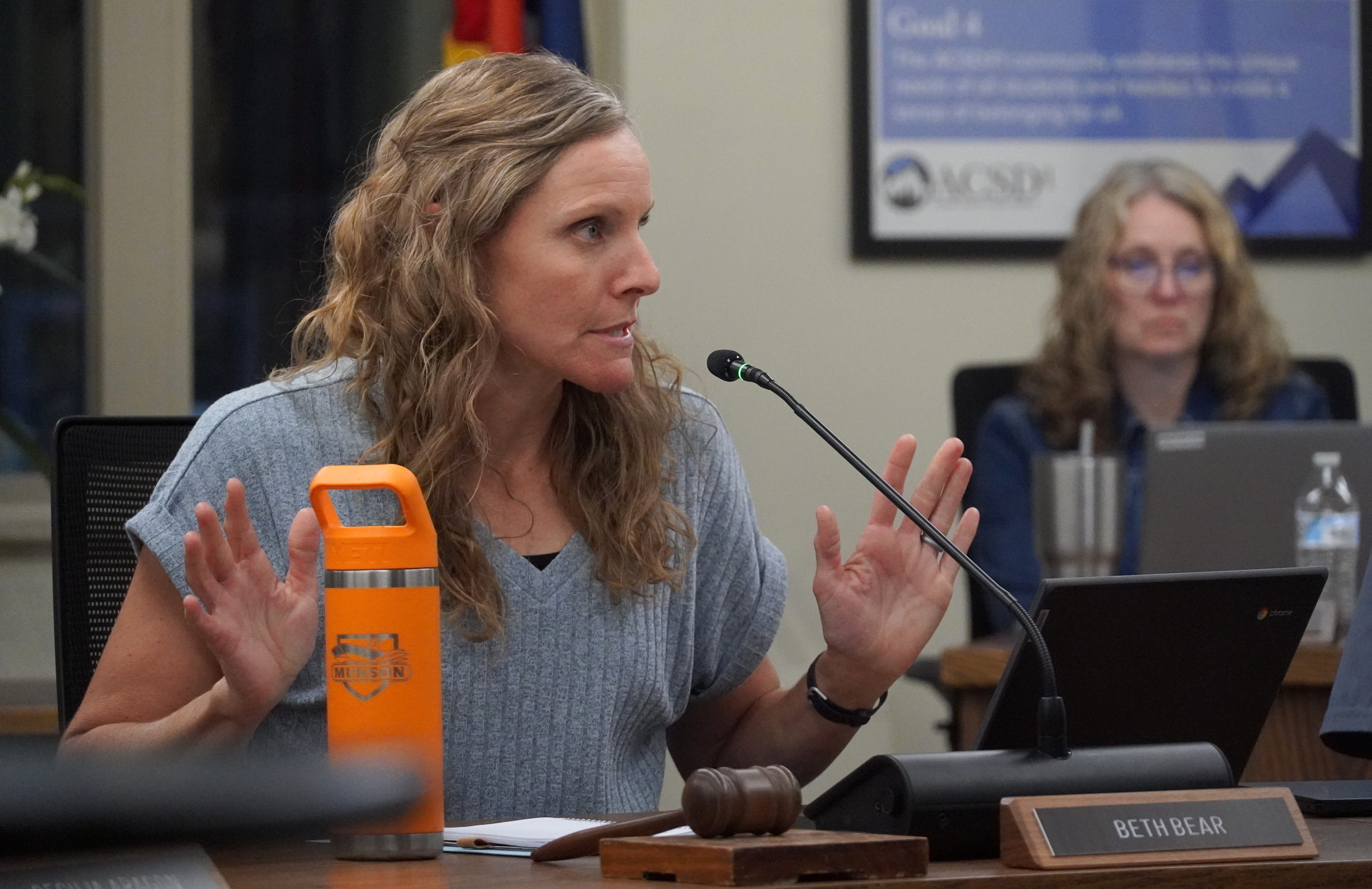
Every member of the Albany County School Board voiced a clear opposition to the proposed legislation, railing against it as an attack on public education, an infringement on local control, and a dangerous development for marginalized students, especially those already most at risk of suicide or sexual abuse.
Trustee Sophia Gomelsky, the school board’s newest member and a recent graduate of Laramie High, shared a quote from her favorite book:
A rat in a maze is free to go anywhere, as long as it stays inside the maze.
Gomelsky said the quote “captures exactly what this bill represents.”
“It tells students that they’re free to learn, free to explore and free to grow — but only within the narrow confines of what politicians decide is acceptable,” she said.
The line comes from The Handmaid’s Tale by Margaret Atwood — a novel dealing with themes of patriarchy, religion and sexual assault. Like other books which tackle these topics, The Handmaid’s Tale has itself been the target of book bans nationwide.
“Once the state takes power to decide what has value and what doesn’t, that opens the door to removing books not because they’re obscene, but because they’re inconvenient, or politically inconvenient,” Gomelsky said. “And because they challenge and they teach young people to think critically about politics, identity and power.”
The draft bill will make its next appearance in Cheyenne on Oct. 13 during a planned meeting of the State Legislature’s Joint Judiciary Committee.
Chestek “absolutely” opposes the bill, Crum opposes it “as written”
The judiciary committee first discussed banning books from libraries in May, and first considered the draft bill in August.
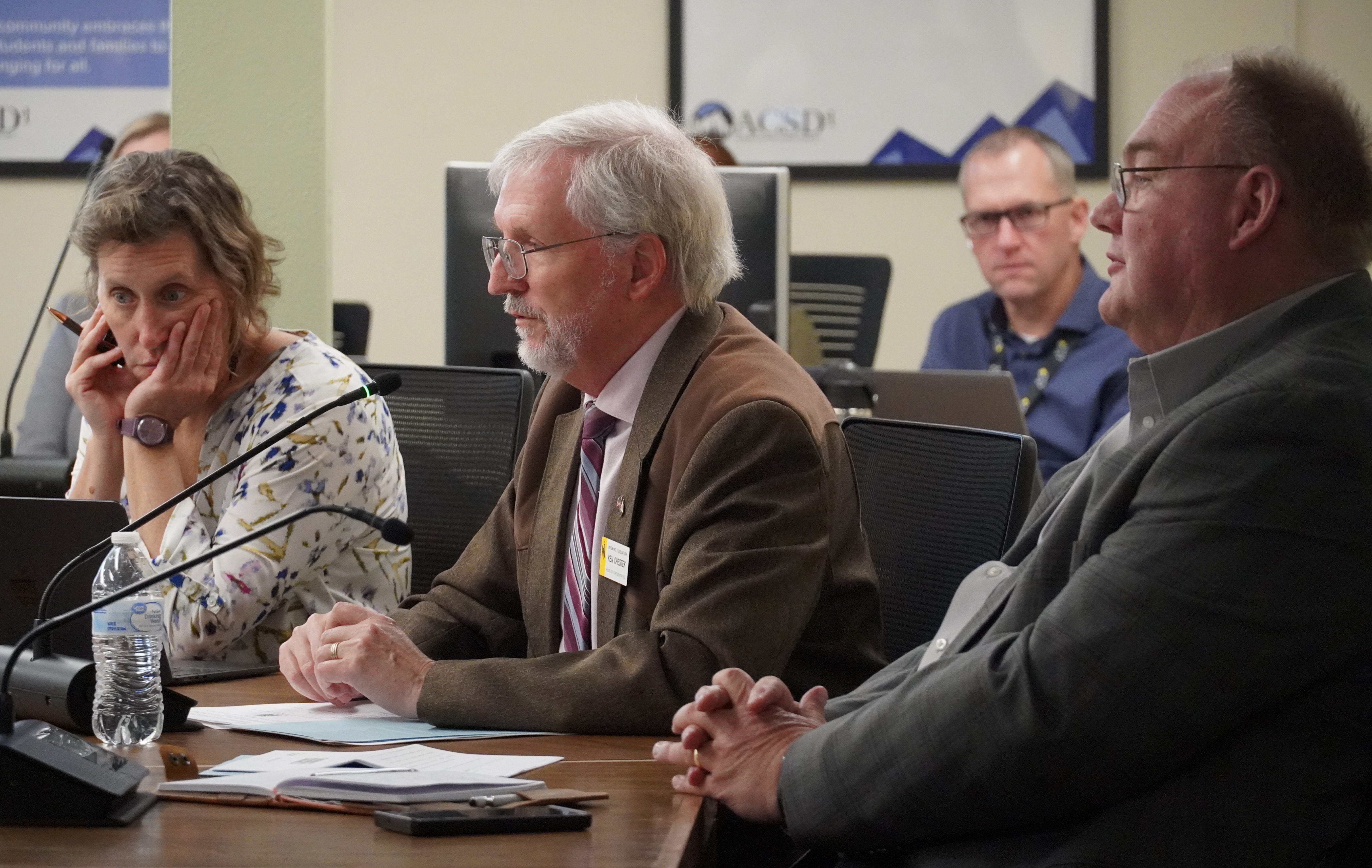
Albany County’s committee members, Rep. Chestek and Sen. Crum, attended the school board meeting Wednesday to gather feedback from constituents. They each voiced their distaste for the new legislation, at least as it’s currently written.
“I’m against the bill. I think there’s a lot of work to be done on it. I’m not sure it comes even out of committee,” Crum said. “As it’s written, I got to say: It’s a solution looking for a problem.”
Crum said he was opposed to pornography in general and especially to its presence in schools, but agreed with other stakeholders that parents should not be allowed to ban books for other people’s children.
However, the senator did not rule out the possibility of supporting some amended version of the bill down the line.
So far, lawmakers have proposed nearly 20 separate amendments which could significantly reshape or soften the original proposal.
“As the bill is written right here, I’m voting against it,” Crum said. “As we work the bill, I can’t tell you how I’m going to vote.”
Chestek, the committee’s only Democrat, took a harder stance.
“I absolutely oppose the bill. I think it’s a bad bill. It’s a terrible bill,” the representative said. “I have, as you know, proposed a number of amendments to make the bill less bad … I’m hoping that we’ll be able to mitigate some of the really awful parts of this bill.”
Chestek noted later in the night he plans to vote against the bill even if his amendments pass.
A law professor by day, Chestek said his biggest concern with the bill is that it goes beyond the “Miller test.” That’s the legal standard for determining “obscenity” established in 1973, and it’s already baked into Wyoming State Statutes under 6-4-301(a)(iii).
The Miller test involves examining whether a book or other piece of media appeals to a “prurient interest” and whether it contains “serious literary, artistic, political or scientific value.”
“That’s not what this bill does,” Chestek said. “This bill goes way, way beyond the Miller test, and it bans anything that’s ‘sexually explicit.’ So, sex education materials — you have to be sexually explicit to teach that course, but you can’t teach the course now, because you can’t have those materials.”
The draft bill would define as “sexually explicit” any pictures or words depicting two or more people engaging in numerous, detailed ways involving “penetration,” “ejaculation,” “artificial sexual organs” or other terms WyoFile has described as “injecting an unusually carnal note into Wyoming politics.”
The bill’s supporters say the graphic descriptions are intentional; they are meant to ban material not banned by the Miller test by removing the need to consider a work’s literary, artistic or other value.
Chestek also took issue with the bill’s origin.
“I don’t think it came from Wyoming,” he said. “I think it came from a national agenda. This is happening in other states and some people went, ‘Oh, it’s happening there. We should do it here, too.’”
The Wyoming draft is similar to a 2023 bill passed in Iowa, which has been, and continues to be, challenged in court.
Wyoming’s legislature — consistently Republican and historically libertarian — has veered farther to the right in recent years, targeting LGBTQ+ rights and DEI efforts in schools and colleges among other issues. This rightward swing has been driven by the Wyoming Freedom Caucus, which now controls the Wyoming House.
Caucus members are leading the charge on the new book ban.
“It came from members of the Freedom Caucus,” Crum said. “I can’t say it came from the Freedom Caucus.”
If the bill passes, it won’t be the first time the Albany County School Board has been forced to enact the will of Wyoming’s right-wing leaders.
In 2024, the trustees adopted a forced outing policy required by a new state law — despite warning that such a policy would endanger students. Earlier this year, Wyoming eliminated gun-free school zones, and the Albany County trustees approved the most stringent training requirements they felt they could justify for employees who wish to carry concealed firearms.
This week, before a packed room, the trustees fiercely condemned the proposed book ban.
School board trustees call out state lawmakers, teachers fear for their students
One by one, each school board trustee voiced their opposition to the draft bill, calling it “government censorship” and “bad beyond belief.”
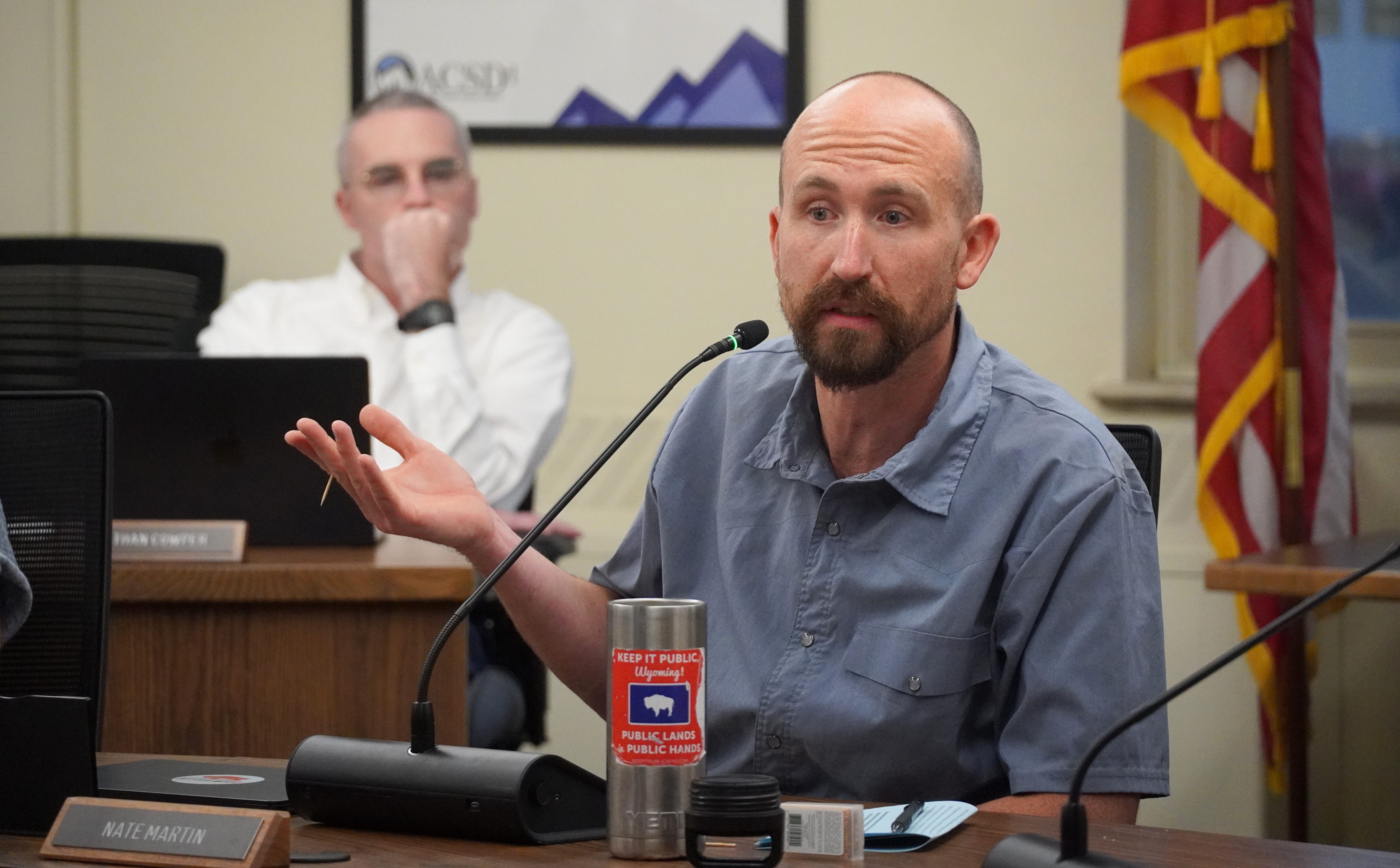
Trustee Nate Martin was unequivocal in making his disgust known.
“In Wyoming, you can get married at 16 years old; a 16-year-old girl can marry an adult and enter into a sexual relationship in the eyes of God and the law and everybody else,” Martin said. “And passing a law that says that girl can get married and have sex, but can’t check out a book from her public library about sex, just seems like creating an incongruity in our statutes.”
The comment was a jab at Wyoming’s most right-wing lawmakers, who have, in recent years, fought efforts to end child marriage in the Equality State. Several high-ranking members of the Freedom Caucus voted against a 2023 bill raising the minimum marriage age.
“It’s not about protecting children,” Martin said. “The intent of the law … is to tear down public education. It’s not a coincidence that this law comes forward at the same time that laws come forward to pull money away from public schools and give them to vouchers, and laws come forward to say that teachers don’t need to be certified in order to teach, and so on and so forth. It’s part of the same package.”
Jennifer Bennett, a local English teacher, said the bill was bigger than public education, noting that it “risks limiting access to diverse ideas and resources, especially in county libraries meant to serve a broad public.”
“The proposed $50,000 fine per violation is excessive and should not be considered at all,” she said. “To my knowledge, no other Wyoming law imposes such a steep penalty for a first offense. Such a fine creates an environment of fear and could discourage librarians from providing valuable resources.”
But Bennett said it will also have devastating effects on schools and the children they serve. She said her students are particularly concerned about losing access to books about mental health topics.
“There are students who have families that do not discuss these topics, and this is their safe place,” she said. “This is a place where they find a home, where they find comfort.”
Trustee Emily Siegel-Stanton said that’s especially true for LGBTQ+ students.
“There’s a lot of kids who in their homes don’t have access to information about healthy and safe relationships,” she said. “And a lot of kids who don’t have access to positive representation of LGBT relationships and LGBT healthy development of relationships.”
Book bans frequently and disproportionately target books about or for LGBTQ+ youth.
Maia Kobabe’s Gender Queer, an acclaimed graphic novel detailing the author’s own journey of self-identity, is regularly among the most banned books in the United States. David Levithan’s Two Boys Kissing, a 2013 young adult novel, and other books about growing up queer, have been targeted during earlier rounds of book banning in Wyoming.
Siegel-Stanton said this targeting stems, in part, from the sexualization of queer relationships. While straight relationships are allowed in media for all ages, the mere presence of gay relationships is viewed as making the entire work sexually explicit.
Siegel-Stanton said the focus on LGBTQ+ books and education also stems from the myth that such media will “cause kids to be gay.”
“I can tell you that, growing up, all of the information about straight relationships that I consumed didn’t make me straight,” she said.
But having “a wide range of representation in our libraries” does have an impact, Siegel-Stanton said. It helps children — especially the most marginalized and bullied children and those “who might not have access to critical information at home” — find the stories and resources they need to understand and accept themselves.
“I can’t speak for everyone, but many of us know homophobia before we know we’re queer,” she said. “I know that this is true for my story … So I feel passionate about trusting our professionals who have studied child development, who know what their age groups need to read and need to access, be the ones to make the decisions about what’s in the libraries.”
Thank you to ACSD#1 and the Laramie public for standing up for literary freedom and our children's ability to access critically important educational materials! The Freedom Caucus needs to worry about the myriad ACTUAL problems facing Wyoming rather than trying to turn our state into a neo-Puritan society.
Thanks to everyone who condemns and opposes this outrageous book banning bill.